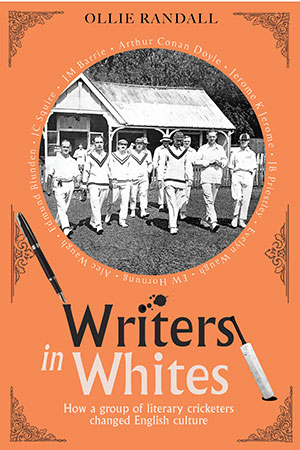
My last review was also for Fairfield Books, Catching the Light, and Ollie Randall's first book, Writers in Whites, is of a similar genre. As I also wrote in Catching the Light, cricket has this propensity for attracting a wide range of subjects on which many aspects of the game have been written.
Writers in Whites charts the rise and progress of literary teams and includes some of England's most famous writers including Arthur Conan Doyle, J.M. Barrie, Jerome K. Jerome, E.W. Hornung through J.C. Squire, Alec and Even Waugh, Edmund Blunden, J.B. Priestley, P.G. Wodehouse and many others. Many of them come across as fascinating characters.
My first recollection of literary cricket teams actually came almost thirty years after reading an excellent World Cup book, Hell for Leather, by Robert Winder, a member of Harold Pinter's Gaieties team. Pinter is also mentioned in Writers in Whites.
Ollie Randall's biography on the inside cover describes him as a writer, historian and cartoonist. First of all, I must mention that he has researched his subject - whose result comes about after a four-year PhD in the form of this book - meticulously and one can see the enjoyment derived in the way he has written it.
There was a reason for starting literary cricket teams. It enabled those who played the opportunity of networking, making their names better known whilst also having some fun on the cricket pitch. The first major literary team was the Allahakbarries - the derivation of whose name will be revealed within the book's pages - founded by J.M.Barrie whose enjoyment of cricket becomes obvious.
It also becomes noticeable that some of the names which we might have read about in some of the cricketing authors' books have been based on fellow cricketing colleagues. Some authors were decent players: Conan Doyle, for example, had one first-class wicket, the rather notable scalp of W.G. Grace. Tours were arranged as the team took off.
Some of the organisational arrangements of some literary teams have enjoyable tales told of the prevailing haphazardness of them. Having run a midweek team for seven years which often relied on players being able to leave work on time, I understood, without approving of the occasional epithet that we were a "3 p.m. for 2 p.m." team. I am relieved to read of some of the goings-on in Jack, later Sir John, Squire's team.
I am also delighted to come across a couple of examples of people known to me over the years that I have played cricket and shows how cricket information and titbits can appear in the most unexpected of places.
Throughout the book, one notices the change in the times between the period which the book encompasses, the 1880s to the 1960s. Later, literary teams would include famous England and Australian players. I have seen and had some involvement with celebrity/charitable cricket teams and the literary teams mentioned in Writers in Whites strike me as a forerunner and therefore it is terrific to have Ollie's book.
At the end of Writers in Whites, Ollie mentions that a reincarnation of an Authors team started up a few years ago and I am delighted to see that Fairfield Books is well represented with the three from Catching the Light as well as Jon Hotten whose excellent book on Sir Geoffrey Boycott was published in 2022 in an Authors XI.
Very well done to Ollie on this fascinating and enjoyable book. I see that his second book, Lord's and Maharajas, is due out later this year and I can safely say that I have my eye out for it...