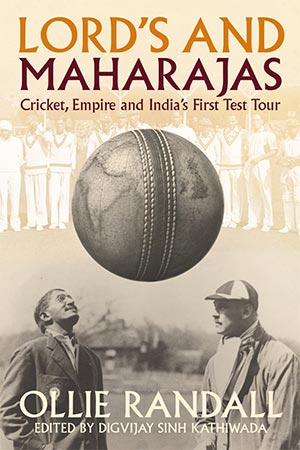
Having been to India on many occasions and love Indian cricket, I had been very much looking forward to Ollie Randall's second book. From my visits to India, I knew about the princely states and their rulers and, from my interest in Indian cricket, knew that the country's Test bow was at Lord's in 1932. Lord's and Maharajas has told me so much more about the effect that princely states had in India during that time; the earlier plans for India's first Test; the imperial considerations and what was happening in India during British rule and why it was at Lord's that India's first Test was held when the plan had ideally been for it to be played in India.
The first point which caught my eye was the front cover with Ollie's name as the author but that it had been edited by Digvijay Sinh Kathiwada. I was delighted to see that Ollie's first book, Writers in Whites, has been so well received and shortlisted for one of the cricket books of the year awards so my initial first thought was why does he need an editor? The answer is simple and very relevant. I would urge readers to start on page four of the book. Both Ollie and Digvijay have collaborated to produce a memorable book.
Lord's and Maharajas tells the story of the previous efforts to hold India's first Test before 1932; the entire coverage of the 1932 tour with its exhaustive itinerary including, naturally, the climactic first Test as well as all the political and imperial machinations and intrigues, a word which appears regularly, and the regular stumbling blocks encountered along the way.
To understand India better, and especially 100 years ago, the choice of captain was always likely to be a prince. Not that there was anything peculiar about this: West Indies, who had been admitted to Test cricket shortly before India, were usually captained by a white man and it seems that India selected a prince so that all different religious groups included in the team's make-up would be held together by a ruler of a princely state. It seems that it was a tough task both on and off the field for Natwarsinhji, the Maharaja of Porbandar. The team was a mix of Hindus, Muslims, Parsees and Sikhs so that the title of the team, All-India, accurately reflected the constitution of the country.
I am delighted to find out so much more about the Maharaja of Porbandar who is just one of four such people mentioned in the book. Whenever the Maharaja has been mentioned previously, it has usually come along with the quip that he owned more Rolls Royce cars than he made runs on the tour. Which cannot be disputed: his two runs on the tour came in three matches before he stood aside. The pressures, both diplomatic - there was frequent trouble within India over British rule - and on the field, would have been immense and, suffering from a recurrence of malaria, the Maharaja made the sensible decision to stand aside whereupon another prince, who had also been selected, could take over. It would, though, be the legendary C.K. Nayudu who would lead India in the Lord's Test and the intrigue which many, myself included, would have been unaware of until now, unfolded just hours and deep into the night before the toss. Ollie and Digvijay write in a spellbinding way and I found it difficult to put the book down.
Not that Natwarsinhji was the only such person considered as captain. Others had ambitions and the book tells the tales of what happened behind the scenes before Natwarsinjhi was made captain. With the British public keen to see the Indian cricketers, the demands on Natwarsinhji were immense with many speeches to be made, a royal visit to attend and keeping harmony amongst the team. It seems that he did an excellent job.
We also learn about the colourful Maharaja of Patiala, Bhupinder Singh; more about the famous England player, Kumar Shri Ranjitsinhji and his nephew, Duleepsinhji as well as the Maharajkumar, the son of the Maharaja, of Vizianagaram, known as Vizzy. Readers may have heard more about Vizzy who might have led the 1932 tour but did so in 1936 in a tour which had many more difficulties than the one in 1932. We find out how the BCCI came into existence at the delightful Roshanara Club ground in Delhi which has hosted domestic cricket this century.
Lord's and Maharajas has been an eye-opener and terrific book to read and I would urge anyone even remotely interested in Indian cricket to buy a copy. I would like to extend my congratulations to Ollie, Digvijay and Fairfield Books (for, needless to say, an excellently put-together book) on this memorable work. And I would not be surprised to see it shortlisted for a cricket book of the year award either.